
 All-in-one solution
 Customer centric
 Pricing Expertise
 Pricing FAQ
 Success Stories
 Content HUB


📌 TL;DR
- The Myth of 100% Autonomy: Pricing AI isn’t magic; its success depends on corporate culture and team engagement
- The Trap of Corrupted Data: The algorithm doesn’t correct human errors at the source (as illustrated by the “Afghanistan effect”)
- Two human pitfalls: When faced with the tool, teams oscillate between rejection (skepticism/circumvention) and blindness (loss of critical thinking)
- The danger of drift: Without regular human review, AI continues to optimize based on past behavior and erodes margins
- The ideal partnership: AI excels at automating massive volumes; humans remain indispensable for handling the unexpected and defining strategy
Discover the full article below ⬇️
If you listen to the executive committees of major retailers or browse software vendors’ brochures, the verdict seems clear: the pricing manager’s job is on its way out. The myth of autonomous pricing has taken hold. You install a large language model (LLM) or a reinforcement learning algorithm, sit back, and watch the margins climb.
But the reality of retail is quite different. As a researcher at INRIA, I spend my days deep in data science and at the heart of companies’ pricing committees. And what I see on the ground is a vast chasm between management’s fantasies and the operational reality of stores and e-commerce sites. AI is a remarkable tool, but it isn’t magic. If the failure and abandonment rate remains so high, it’s because we too often try to implant a technology without understanding the culture of those who operate it. Push the transplant too hard, and the body rejects it.
To make this human-machine transplant work, we need to look honestly at what is actually happening, step by step, across the entire lifecycle of AI.
Act I: Before, The Clash of Expectations and the “Afghanistan Effect”
Everything begins well before the first line of code is written, in a phase where contradictory expectations collide. On one side, leadership wants to automate in order to cut headcount and compensate for a sometimes unwarranted distrust of their teams’ instincts. On the other, frontline staff harbour fears of a great displacement and a nagging sense that they’re about to be policed by a tool incapable of grasping the subtlety of a commercial tactic.
It’s in this context that you hit the first wall: data quality. Management often imagines that artificial intelligence will miraculously clean up the company’s historical records. That’s a complete illusion. AI will never fix data that was corrupted at source by human processes.
One anecdote has since become a case study in my career: during an audit for a large hotel group, leadership wanted a detailed analysis of booking patterns broken down by length of stay. Diving into the database, we found a surprise: 70% of guests were registered as Afghan nationals. Why? Simply because Afghanistan happened to be the first option in the check-in software’s country dropdown. To move quickly and close out a booking, staff would click without actually making a selection. If you feed your optimization model with biased data, the algorithm will calculate perfect prices for a market that doesn’t exist.
The same problem surfaces when trying to assess the return on investment (ROI) of these tools. You see magic numbers bandied about, promises of overall gains of 6% or 15%. But a global ROI figure that isn’t broken down by product or market segment, distinguishing national brands from private labels, or loss leaders from everyday shelf staples, is a meaningless indicator, an unachievable target. Without a rigorous internal audit carried out in close collaboration with the business teams, you doom the project before it’s even off the ground.
Act II: During, From Human Resistance to the A/B Testing Trap
Then comes the critical deployment phase. This is a high-pressure period where everything happens at once: testing, acceptance testing, redefining processes, and cleaning data on the fly. For pricing teams, it’s a moment of profound instability. They’re being asked to abandon their longstanding management rules, those beloved Excel-based business rules, and place their trust in the machine’s recommendations. It’s nothing short of a cognitive big bang.
This is where two extreme and equally dangerous behaviours tend to emerge. The first is that of the “sceptic“, the old-school merchant who refuses to let a black box dictate their decisions. They will actively work around the tool, manually override prices to revert to their old habits, or engage in what might be called Shadow Pricing: recalculating the price on the side with their own spreadsheet to check whether the machine has got it wrong.
The second profile, with subtler but more insidious consequences, is the “true believer“. Often younger, they place blind faith in the algorithm, it’s a kind of automation intoxication. This is the phenomenon of cognitive offloading: delegating the thinking to the tool. If the machine says to cut the price by 20%, they approve it without trying to understand the impact on brand perception or anticipate the medium-term fallout. By ceasing to exercise critical thinking, teams gradually lose their commercial instincts and their feel for the market.
To guard against these pitfalls, a company’s maturity might well be measured by its ability to run rigorous, ongoing A/B testing protocols. In traditional French retail, there’s a strong temptation to pull the plug on tests the moment initial results look promising. What’s forgotten is that a recommended price is not an absolute scientific truth: it’s a hypothesis about customer behaviour, necessarily aggregated and contextualised, that must be validated against a control group. To break down resistance, the use of simulators and serious games (digital twins of the market) can serve as an excellent educational bridge, immersing both senior management and operational teams in extreme scenarios. It’s a humbling experience to discover you’ve lost one game in five against an intern
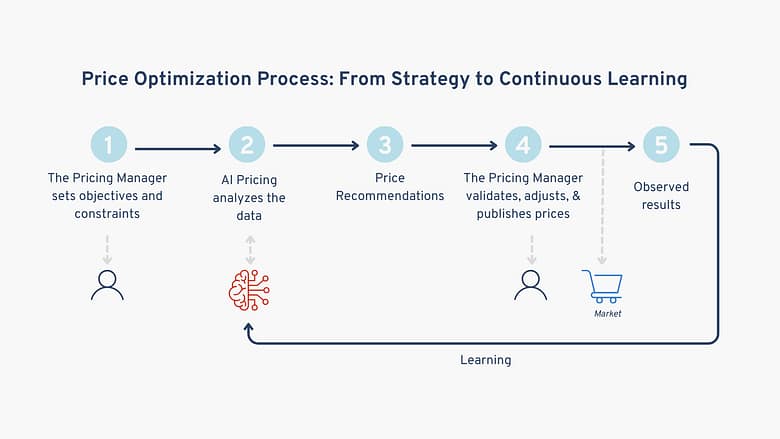
Act III: After, Data Drift and the Illusion of Autonomy
Let’s imagine the transplant has worked. The AI is up and running, the teams are on board, and the tool has reached cruising speed. This is precisely where the final and most invisible trap springs: drift.
A pricing model is calibrated at a given point in time, based on specific consumer behaviour within a specific context. But customers change, generations shift, and new competitors, such as hard discounters or second-hand platforms, enter the market. Price elasticity for a product in France during a period of inflation is not the same as during a period of stability. If you don’t organise regular model reviews, a kind of “100,000-transaction service check”, the AI ends up optimising for past situations and silently eroding your margins.
On top of this, French retail faces growing opacity across its distribution channels. When you sell directly to consumers, you control your price. But when you’re distributed through a third-party marketplace (such as Amazon), you become dependent on that platform’s algorithm and its notorious Buy Box. Losing the top spot in that purchase widget can cause your volumes to plummet by 80% within hours. Here, your internal AI must no longer simply set prices, it must serve to decode and model your distributor’s AI, to understand how it behaves and, above all, to anticipate its next move.
Finally, AI suffers from a chronic inability to factor in the “unthought”: the major external event that simply doesn’t exist in historical data. A massive supply chain failure, a health crisis, a sudden weather event, or a political decision. This is where human-machine collaboration comes into its own. AI excels at processing vast volumes of competitive pricing data and automating routine micro-adjustments. Humans, on the other hand, remain the only ones capable of anticipating context breaks and taking back the helm when the machine ventures into uncharted waters. As one wind energy trader put it: “I make my living three days a year, I just never know which ones.”
Conclusion: Towards a Clear-Eyed Coexistence
Implementing artificial intelligence in pricing is not merely a mathematical and technical project, it is a cultural transformation. Moving away from a world of gut instinct and sprawling Excel spreadsheets must not come at the cost of abandoning our critical thinking or our sensitivity to the question of “what could go wrong?”
The goal is not to replace the merchant with the algorithm, but to build a partnership where the machine frees the human from repetitive cognitive load, giving them back their true role: that of strategist. A partnership that recalibrates continuously and whose progress must be measured over time. And you, how much money did you leave on the table last week?
Would you like to learn more about the transition to smart pricing and human-machine collaboration? Click here to contact one of PricingHUB’s experts to find out more!

